

Well, I have finally buckled under mounting pressure (from my subconscious) and purchased an NZ120 scale H loco in FUD. Total cost including postage was $75NZ, which I don't think is too bad for this model. Its all quite/dangerously simple with Paypal. The order is then sent into the printing que. Last night I received this 'informative' e-mail.
>Exciting update! We're in the midst of creating your order in our factory of the future.
Hmm, OK guys, a bit too much of the corporate kol aid this morning I think.
>Once our robots have finished creating your order and we make sure
it's perfect....
I think this is a relative term.
The most amusing thing at the end is the warning.
>Warning: Please note that the 3D printed products are intended
for decorative purposes. They are >not suited to be used as toys or to be
given to underage children. The products should not come in >contact
with electricity and be kept away from heat. Our materials, except for
3D printed glazed >ceramics, are not food safe.
OK, so at least I'm not planning to eat it.
(BTW acrylic is an excellent insulator with a melting point of about 90C so unless the chip or motor bursts into flame it should be fine).
I must now pay the Atlas website a visit to get the motorising bits.
Thursday, March 14, 2013


Sunday, March 10, 2013
Ab II
I managed to spend a little bit of time in the Man-sion today despite being roped in to chopping down several trees outside. will this cursed fine weather never end? Maybe I should start building an outdoor railway?
Anyway, its was a chance to do some more on the Ab. Primarily to get the wheels fitted. A hunt through a collection of boxes (and under at least one wagon) turned up 4 spoked peco wheelsets for the tender and a couple of Parkside Dundas wheelsets for the loco bogie. The tender bogie had immediate problems.
The wheels for the loco bogie were a bit easier. I removed the wheels and then filed the pinpoints back to flat to suit the inside frames. the photo shows that I will probably have to fabricate a new front bogie with a wheelbase that's a tad longer. Oh and larger cylinders as well.


One end is the correct height, and the other isn't. I'll have to do some plan checking to determine which one is the odd man out. My gut is telling me that the tender looks too high all round, especially the trailing headstock. Other than that, Its a good place to start. I like that its square, something normally beyond me.
Anyway, its was a chance to do some more on the Ab. Primarily to get the wheels fitted. A hunt through a collection of boxes (and under at least one wagon) turned up 4 spoked peco wheelsets for the tender and a couple of Parkside Dundas wheelsets for the loco bogie. The tender bogie had immediate problems.
 |
| 'Oh, and I broke the printed bogie pin too' |
Printing a model designed for 1:120 up to 1:105 and still want it to sit on N gauge track is a bit short sighted. I drilled some holes in some plastic sheet and cut them out to use as spacers. Fortunately the loco isn't required to move. This makes things much easier.
 |
| 'Oh, and I broke the other printed bogie pin too' |

Then I put it all together to see how it looks.

One end is the correct height, and the other isn't. I'll have to do some plan checking to determine which one is the odd man out. My gut is telling me that the tender looks too high all round, especially the trailing headstock. Other than that, Its a good place to start. I like that its square, something normally beyond me.
Saturday, March 09, 2013
Saturday musings
I've been having a bit of a ponder this morning about the various models from Shapeways, and how things could be improved. Looking at this picture this morning gave me some pause for reflection on how far things have progressed.

If any of this had been attempted in another medium, there would have been some major work involved. Different sides, ends and details would have to have been made. These would then have to be purchased, bundled up correctly by the manufacturer and sold. If the variation you wanted was out of stock, 'sorry thats your tough luck you should have brought one sooner'. The bonuses using this tech are great for a manufacturer. you don't have to carry any stock as the model is never out of supply. You don't have to spend your spare time doing that actual physical stuff that selling things entails (packing, posting etc).
One thing that I would change (if I was doing it) would be to possibly move away from the 1 piece model theory. The current level of technology generates models with some ridging (due to the process printing in layers). This can be easily removed but gets to be more challenging when details are in the way. taking the above example are the roof ventilators and collection of handrails (which In my experience tend to be brittle as well). My preference would be for these to be separate pieces, with locating holes on the main body. Handrails may well be better served by being etched from brass (if they could not be printed).The British have a 'large/sizable' cottage industry supplying extra detail parts for RTR models (and kitsets) so maybe theres a chance for a similar sort of thing to happen here. Possibly one answer would be to do 2 models, the first a 1 piece model with all the bits attached, and the second a 'clean' model for superdetailers to start from (its really nice to have a basic square form thats beyond my skills as a start point). Maybe the detail parts could be printed on a separate sprue, or even supplied by a different company, as MMW has done for the trackgang DF/DFT and Dx kits.
If any of this had been attempted in another medium, there would have been some major work involved. Different sides, ends and details would have to have been made. These would then have to be purchased, bundled up correctly by the manufacturer and sold. If the variation you wanted was out of stock, 'sorry thats your tough luck you should have brought one sooner'. The bonuses using this tech are great for a manufacturer. you don't have to carry any stock as the model is never out of supply. You don't have to spend your spare time doing that actual physical stuff that selling things entails (packing, posting etc).
One thing that I would change (if I was doing it) would be to possibly move away from the 1 piece model theory. The current level of technology generates models with some ridging (due to the process printing in layers). This can be easily removed but gets to be more challenging when details are in the way. taking the above example are the roof ventilators and collection of handrails (which In my experience tend to be brittle as well). My preference would be for these to be separate pieces, with locating holes on the main body. Handrails may well be better served by being etched from brass (if they could not be printed).The British have a 'large/sizable' cottage industry supplying extra detail parts for RTR models (and kitsets) so maybe theres a chance for a similar sort of thing to happen here. Possibly one answer would be to do 2 models, the first a 1 piece model with all the bits attached, and the second a 'clean' model for superdetailers to start from (its really nice to have a basic square form thats beyond my skills as a start point). Maybe the detail parts could be printed on a separate sprue, or even supplied by a different company, as MMW has done for the trackgang DF/DFT and Dx kits.
As always, comments from the peanut galley welcome.
Friday, March 08, 2013
handy
Just occasionally its handy to work in the sciences Like when large insulated boxes turn up.
(I had to share with a workmate , and he might use his as insulation).
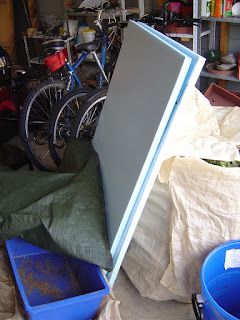
(I had to share with a workmate , and he might use his as insulation).

Thursday, March 07, 2013
Ab's away
Tonight I got a chance to have a go at the first layer of paint on the Ab. Sandpaper and a knife were the order of the evening. From the photo you can see how it went. I think I need to get some more grades of sandpaper.

I'm not sure how to attack the boiler, but that can wait as I'm planning to work on the tender first. This will be split into work below the footplate and the footplate itself.

I'm not sure how to attack the boiler, but that can wait as I'm planning to work on the tender first. This will be split into work below the footplate and the footplate itself.
Monday, March 04, 2013
Getting Stoned: Ballasting 101
DB returns briefly:
Apologies for my absence, I've been away playing in American N. But after sending an Aussie some NZ120 pics yesterday, this particular dimension of my modeling mind - which seems inhabited by more and more personas these days - was awakened.
So why not get around to ballasting that nasty Broken River section of track and take a few pictures while I'm at it. We used to do these 'how to's quite a bit on the blog, not only for those starting out, but also as a way of sharing tips and tricks via comments left by far better modelers..
A lot of people hate the job of ballasting, but not I. It's one of those things that once done, suddenly makes your layout seem more real, so it's worth doing; but it's also one of those things the can really bugger up smooth running track and expensive points so it's worth doing well.
I like to ballast late in the cycle. If you ballast before doing a lot of your other scenery, no matter how well you protect the tracks, you usually end up with plaster, paint and bits of greenery on your ballast which is almost impossible to get out. The only thing you have to worry about if ballasting last, is that you have to be careful not to flick ballast all over your scenery into to places it shouldn't be.

So for the ingredients:
OK, on with the show...
1. The first step is to prepare your track. Finish your soldering, paint the rails, replace any sleepers that are missing where you joined sections of track together. I've done a sloppy job here on this recycled flextrack on all of the above because I hoped nobody would ever see it. Damn and blast this blog.
2. Dump some ballast on your track with a spoon or a small section of card with a V folded in it, or however you prefer. I suppose the 9-mill guys actually dispense ballast from scale YC wagons. Use a brush to tame the wild ballast. I like to apply ballast between the rails and use a brush to move it along the track - some will spill out to cover the sides. I like to go back and forth with the brush to get the ballast level below the tops of the sleepers as I find this to be prototypical on all but the dingiest of old sidings. This also ensures your flangeways are clear. Running a small screwdriver or pointy item fairly quickly along the 'spikes' of the inside of the rails tends to vibrate the ballast away from the flangeways too. You are now left with:
 3. 'Wet' everything. If you put glue onto dry ballast, it will often blob up and do all sorts of unfortunate things to the stones you have neatly arranged. Dampening the ballast first lets the glue to meld and flow into this wetness without upsetting your fine work. I use a sprayer for big swathes of scenery, but for ballasting, I've become fond of these little pipettes as a sprayer can blast your nice tidy ballast all over the place. It might seem slow and painful but it isn't, even if you have some ground to cover. I applied ballast, wetness and glue to this 8 foot section in about 10 minutes.

4. Apply glue. Either by dribbling it from your diluted PVA bottle or with your pipette - which I find easier to be more precise with. If you squirt the glue too hard or apply it from a high altitude, you'll create troughs and craters in your nice ballast. If you apply too much glue at once, you can end up with glue lakes and rivers which will relocate your ballast all over the tops of the sleepers, into flangeways, and down any slopes. Better to apply liquids moderately and come back to apply more rather than dumping a glue monsoon all at once. At this stage you might apply additional ballast if required to touch up tiny areas - sometimes if you have a sloped ballast shoulder, ridges of scenery might show through. Hmmm... I could have done this pic in Photoshop by making the above pipette white now couldn't I:

5. A final task is to clear flangeways of any errant ballast - much easier to do it now than after it sets. I like to use a fingernail run along the inside edges of the rails for this so you can 'feel' if there is ballast in the wrong places (clean your fingers when you've picked up some mini stones). Some people use an old wagon for this (don't: you'll end up with ballast and glue all over the wheels and they will just traipse this all over your rails) or a screwdriver.
A note on points - I tend to not ballast underneath moving point rails and keep some distance from moving tiebars. I'd rather paint the baseboards underneath these black before laying track. I do ballast up to the frogs at the other ends though and along the sides. Be extra careful of flangeways and to keep water and glue away from seeping into anywhere that moves or conducts electricity (point rail joints and where they touch the outside rails. I'm sure Pointmaster Druff has the correct technical terms for these - I slept through all those Hutt Valley Club pointwork discussions)

6. A final-final thing I like to do for aesthetics is to remove any ballast that has relocated itself onto the top of sleepers during the gluing process. If you find a misplaced rock, dab it with a finger and you'll lift it right up. You can then wipe your fingers on your best jeans to ruin them, or use some other place for your ballast deposits. This pic also looks suspiciously like the one above, although an expert examination should note me probing between the rails rather than clearing flangeways:

7. And there you have it. Once things have set you can:
Apologies for my absence, I've been away playing in American N. But after sending an Aussie some NZ120 pics yesterday, this particular dimension of my modeling mind - which seems inhabited by more and more personas these days - was awakened.
So why not get around to ballasting that nasty Broken River section of track and take a few pictures while I'm at it. We used to do these 'how to's quite a bit on the blog, not only for those starting out, but also as a way of sharing tips and tricks via comments left by far better modelers..
A lot of people hate the job of ballasting, but not I. It's one of those things that once done, suddenly makes your layout seem more real, so it's worth doing; but it's also one of those things the can really bugger up smooth running track and expensive points so it's worth doing well.
I like to ballast late in the cycle. If you ballast before doing a lot of your other scenery, no matter how well you protect the tracks, you usually end up with plaster, paint and bits of greenery on your ballast which is almost impossible to get out. The only thing you have to worry about if ballasting last, is that you have to be careful not to flick ballast all over your scenery into to places it shouldn't be.

So for the ingredients:
- Ballast - as fine a grade as you can get. I prefer grey to this brown for mainlines, but I seem to be out of it and I never really expected anyone to see this abomination anyway.
- Glue - dilute some PVA with water and a few drops of liquid soap/dishwashing liquid to break the water's surface tension. Woodland Scenics also make this nice pre-diluted scenic cement, but it's not cheap. I went through a stage of using latex carpet glue rather than PVAmany years ago, as it leads to quieter running, but it can remain sticky enough to attract dust over time. Be interested to hear what others use...
- Wet Water - (as opposed to Ice or Steam I guess) - water with some of that soapy stuff in it as above. You can also use isopropyl alcohol which sneaks into ballast really well.
- Tools - a brush to corral your ballast and something to apply liquids with.
OK, on with the show...
1. The first step is to prepare your track. Finish your soldering, paint the rails, replace any sleepers that are missing where you joined sections of track together. I've done a sloppy job here on this recycled flextrack on all of the above because I hoped nobody would ever see it. Damn and blast this blog.
2. Dump some ballast on your track with a spoon or a small section of card with a V folded in it, or however you prefer. I suppose the 9-mill guys actually dispense ballast from scale YC wagons. Use a brush to tame the wild ballast. I like to apply ballast between the rails and use a brush to move it along the track - some will spill out to cover the sides. I like to go back and forth with the brush to get the ballast level below the tops of the sleepers as I find this to be prototypical on all but the dingiest of old sidings. This also ensures your flangeways are clear. Running a small screwdriver or pointy item fairly quickly along the 'spikes' of the inside of the rails tends to vibrate the ballast away from the flangeways too. You are now left with:


4. Apply glue. Either by dribbling it from your diluted PVA bottle or with your pipette - which I find easier to be more precise with. If you squirt the glue too hard or apply it from a high altitude, you'll create troughs and craters in your nice ballast. If you apply too much glue at once, you can end up with glue lakes and rivers which will relocate your ballast all over the tops of the sleepers, into flangeways, and down any slopes. Better to apply liquids moderately and come back to apply more rather than dumping a glue monsoon all at once. At this stage you might apply additional ballast if required to touch up tiny areas - sometimes if you have a sloped ballast shoulder, ridges of scenery might show through. Hmmm... I could have done this pic in Photoshop by making the above pipette white now couldn't I:

5. A final task is to clear flangeways of any errant ballast - much easier to do it now than after it sets. I like to use a fingernail run along the inside edges of the rails for this so you can 'feel' if there is ballast in the wrong places (clean your fingers when you've picked up some mini stones). Some people use an old wagon for this (don't: you'll end up with ballast and glue all over the wheels and they will just traipse this all over your rails) or a screwdriver.
A note on points - I tend to not ballast underneath moving point rails and keep some distance from moving tiebars. I'd rather paint the baseboards underneath these black before laying track. I do ballast up to the frogs at the other ends though and along the sides. Be extra careful of flangeways and to keep water and glue away from seeping into anywhere that moves or conducts electricity (point rail joints and where they touch the outside rails. I'm sure Pointmaster Druff has the correct technical terms for these - I slept through all those Hutt Valley Club pointwork discussions)

6. A final-final thing I like to do for aesthetics is to remove any ballast that has relocated itself onto the top of sleepers during the gluing process. If you find a misplaced rock, dab it with a finger and you'll lift it right up. You can then wipe your fingers on your best jeans to ruin them, or use some other place for your ballast deposits. This pic also looks suspiciously like the one above, although an expert examination should note me probing between the rails rather than clearing flangeways:

7. And there you have it. Once things have set you can:
- Pull out any track staples (I often use a staple gun rather than gluing or spiking track down.
- Weather the ballast with some thinned acrylics if you desire - either using an airbrush or a soft paintbrush. Sometimes this can be quite effective - you can run oily dribbles down the middle of the track (DJs) or the outside of the track (DEs) or all over the place (DGs, loco depots). You could use a grey colour to represent areas of heavy sanding (the lift out of Otira) or brown for brake dust or black beside curve greasers.
- Do a final flangeway check with fingernail and/or something metal like a small screwdriver, a dental pick or the pointy bit of a screw works well too.
- Gently vacuum up any errant stones that flicked onto scenery.
- Clean the tops of the rails and play trains.
Anyone else got any tips to share?
Sunday, March 03, 2013
The future
I've been pondering on advances made in the scale in the last year, so this is probably the new year state of the nation 2 months late. One thing that has boomed in the scale is the sudden availability (an explosion) of rapid prototype models. a quick count today gives 7 diesel locos , 2 electric locos, and more surprisingly 8 steam locos. Add to this the locos already available in brass etch or white metal and suddenly the availability of loco power is solved (or at least ameliorated). I would be interested to know just how many of these models have so far been purchased, and how they are coming along on peoples work benches.
One thing that I do wonder about is the brittleness of the acrylic polymer, but thats easily fixed by replacing hand rails with wire. Maybe with some of the more delicate parts replaced with etched items or lost wax brass
And it looks like this new fangled technology may have driven the first nails in the coffin of an old personal friend of mine, resin casting. From memory the last time I used any resin was in Nelson. While I've thought about starting up again, theres always been other jobs further up the list.
It still seems to have its place in the British model railway scene, but I'm not sure if its of much use here.
One thing that I do wonder about is the brittleness of the acrylic polymer, but thats easily fixed by replacing hand rails with wire. Maybe with some of the more delicate parts replaced with etched items or lost wax brass
 |
| 'Obsolete?' |
It still seems to have its place in the British model railway scene, but I'm not sure if its of much use here.
Subscribe to:
Comments (Atom)